
Professor Kaldellis’ new history of Byzantium is out now in the USA and on Kindle everywhere.
In our third conversation we walk through the narrative picking out interesting things to talk about. The creation of Constantinople, Justinian’s personality, Heraclius’ achievements and life under the Sassanian occupation to name a few.
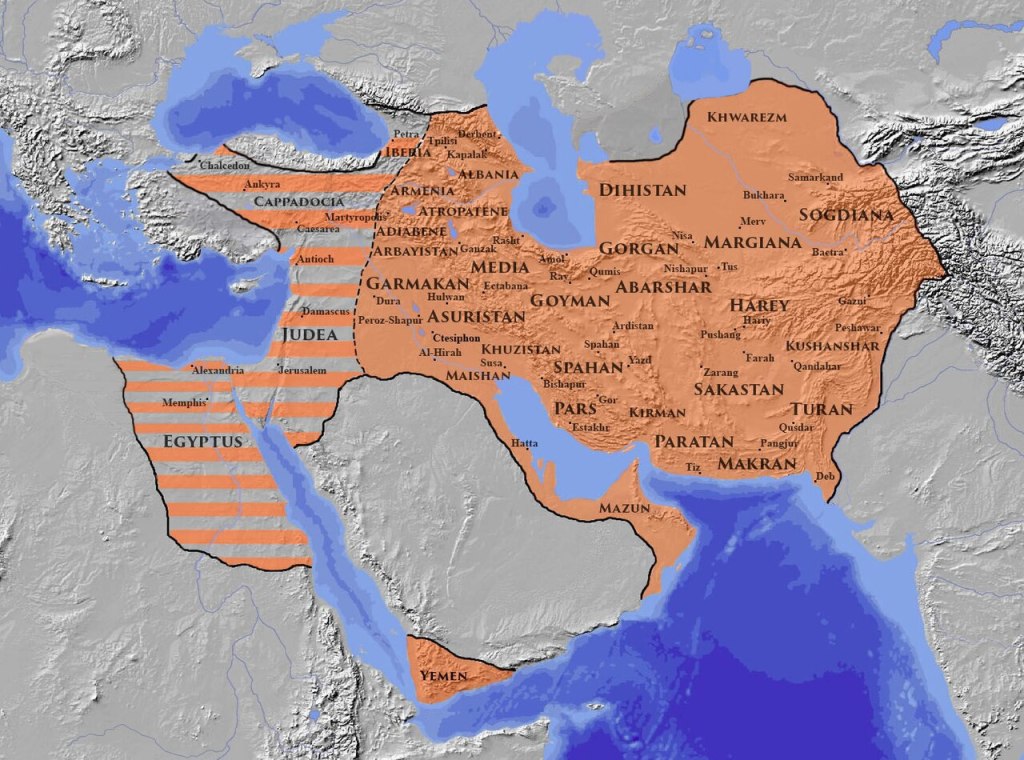
Pic: Map of the Sassanid Empire during the war with Heraclius
Stream: The New Roman Empire with Anthony Kaldellis. Part 3 – The Narrative
Download: The New Roman Empire with Anthony Kaldellis. Part 3 – The Narrative
RSS Feed: The History of Byzantium
If you want to send in feedback to the podcast:
– Either comment on this post.
– Or on the facebook page.
– Leave a review on Itunes.
 The History of Byzantium
Hi Robin! Thanks for all the hard work you put in this!! And I am going to add that you are a great interviewer and love the chemistry in your interviews with professor Kaldellis.
I have a couple of questions:
– I remember hearing about Christians in the Persian empire but can’t remember any mention about Zoroastrians living in the Roman Empire. Is there any information? Temples, artifacts, mentions in official and church documents…
– what are the 2 – 3 main questions regarding New Rome where experts have heated discussions now?
oi oi,, so at the end of this weeks program there was a request for questions to you two right?? If this is the place to post them I have one (please direct me to the right place if not:)! ? to you two Gents,, What are your thoughts on future scholarly and fictional research within the context of fx. byzantine studies considering the AI revolution? Specifically in regards to doing translations of a tremendous amount of varied ancient-language-data? Having to have to master 14+ languages to be able to really sink your teeth into a specific historical epoch is a somewhat time consuming feat, and AI might be of some use for scholars and others in their research… Thanx for being interesting!
-Christian Møller Hansen
Denmark
Yes this is the place for questions and great question
Question for Professor Kaldellis (and to you, Robin, although maybe I should ask it later, once you’ve finished your research for the rest of the narrative) – Lars Brownworth, in his book “Lost to the West”, writes “The last two centuries of Byzantine history make, for the most part, rather discouraging reading. Against an increasingly hopeless backdrop, petty emperors waged destructive internal squabbles while the empire crumbled, reducing the once-proud state to a mere caricature of itself.”
Do you find any difference in your enthusiasm when researching periods of the empire’s expansion and prosperity compared to its decline and fall? Do you think that scholarship in general is affected by this, focusing on high points like Justinian or the Macedonians up to Basil not just because more sources are available, but because learning about the good times attracts a wider audience?
A couple of interrelated questions for both Professor Kaldellis and Robin; in regards to the idea that the loss of Cyprus was a ‘interrupted civil war’, to what extent can the same be said about the initial Arab Conquests of the 7th Century?
I think back to an earlier episode Robin made about this period. In which he pondered if the provinces lost to the Persians being the same ones lost to the Arabs decades later was merely a coincidence? Surely the disruptions to these provinces (Syria/Egypt) and their subsequently brief re-integration into the empire prior to the conquest must have played a significant role in the outcome? Was the outcome a result of a interrupted re-integration of these provinces?
Also, for Anthony specifically: Our sources for this period leave a lot to be desired, and there is a very fluid debate in the scholarship about how reliable they are for reconstructing events. To what extent do these sources allow us to recount the events of the early Arab Conquest beyond the vague generalities, and what methodology did you use to influence your use of them in the book?
Hey, thank you for these. Can you help me with some clarification?
Professor Kaldellis argues that the Arab invasions were centrally directed by an Arab leadership group. A group who wanted to capture both the Roman provinces and Sassanian Mesopotamia (Iraq). So he is not among those scholars who’ve suggested that this might have been some kind of civil war among the Ghassanids and Lakhmids which just got out of control. Or an attempt to take over the Roman Empire to replace the ruling dynasty with an Arab one. So he probably wouldn’t see the reintegration of those provinces as important for what happened right? He would just say that their lack of defences aided the conquest.
It doesn’t sound to me like that’s the answer you’d be expecting or you wouldn’t have asked the question so can you help me with the phrasing?
Actually, that answer would be more or less fine with me, with a bit more elaboration of course.
I guess I can clarify that my question isn’t necessarily a leading one. I don’t attach the correlation in provinces lost with some of the more ‘out there’ theories (like the civil war idea you mentioned). Merely that the success of the Arabs (whether they be a central leadership group or something else) might have been conditioned to an extent by this ‘interrupted re-integration’ of provinces just lost to the Persians, much like the Cyprus example of an ‘interrupted civil war’ given in this episode.
This is made doubly interesting to me by Professor Kaldellis’ objection to the idea that the Persian occupation wasn’t that disruptive. After all, depending on what dates we use, the Arab incursions into the Levant might have started as early as one or two years after it was returned to Constantinople.
Hope that helps, I apologize if my initial question was a bit unclear.
a question for both you and professor Kaldellis
– Is the lack of Byzantine media, may that be film, tv and general fiction, detrimental to the study of The empire or a positive.
I had a similar question that may be best used as an adder to William. I believe this was covered earlier in the podcast but it would be interesting to hear more insight…why does Rome capture so much more of the media attention and the Western mind overall? Why does Byzantium receive almost zero recognition by comparison?
Robin, we have been fortunate to hear from so many experts in the field of Medieval Roman history on your Podcast! I wanted to ask Prof. Kaldellis to react to two statements that I have heard come up at different points of your conversation with him. These statements sound very similar to me but Prof. Kaldellis has disagreed with one and agreed with the other.
Statement 1: “the peasants probably didn’t even notice their country was conquered by the Persians.”
Statement 2: “the vast majority of Christians had no opinion of or no interest in the theological conflicts of the Church (e.g. Arian v. Nicene, Monophysite v. Dyphysite, etc.)”
Can Prof. Kaldellis speak about these two statements and why one might be false while the other is true? Does his reading of the sources make this clear or is this an assumption on his part?
If you feel that’s too complicated a question for your discussion then ask him if he has a view on the “most Byzantine” consumer good was, in the way that “blue jeans” may be seen as an American cultural product, or silk might be Chinese. Even though blue jeans might come from anywhere (and indeed the Romans had their own silk industry), these are still code as American and Chinese, to an extent.
Many thanks!
Hi Robin:
I would like to ask Anthony if there are any big questions that are generally considered by experts to be important and consequential in Byzantine studies, but unanswered.
Somewhat related, how is new information found in this field? I get the impression that most of it is done by historians rather than archaeologists although I have seen a few reports of digging in Istanbul turning up things, etc.
With regard to using existing, known documents for research, is there a danger of that well running dry?
Thanks,
This is just the limitation of writing back and forth rather than speaking. And it’s my fault for not comprehending. I’m still struggling to make the connection. The Cyprus interruption was that neither Isaac on Cyprus or Andronikos at Constantinople had a fleet. So they just gave up fighting each other. Isaac couldn’t leave Cyprus but went on calling himself Emperor when he clearly wasn’t. But Andronikos couldn’t get to him to shut him up.
What’s the connection you’re seeing with the Arabs?
Definitely the war between the Romans and Persians led directly to the Arab invasions. It seems very clear that the collapse of Roman authority would have shocked the Arabs, none of whom would have known anything but Roman bureaucrats and merchants on their northern border. The equally sudden collapse of the Persian occupation then left both Empires looking far more vulnerable and fragile than anyone had ever contemplated before. And the Caliphate was born.
I suppose I can boil the connection down to its basics:
-To what extent was imperial control over Syria and Egypt re-established by the time the Arabs started their raids/invasions?
-What does it look like on the ground when the empire suddenly absorbs such a massive area without taking it back through direct military actions in them?
-Did a potential lack of imperial control in these regions, as a result of their very recent reconquest and very brief re-integration play a hand in the Arabs’ success/swiftness in taking these provinces?
Basically the connection I’m pondering is that, both of these situations’ swiftness come about from control over a region having just switched hands, and political legitimacy/control being in question. Therefore, did the Romans really have much of a presence there yet, after only having retaken these places a few years prior? Did they have any troops or infrastructure there to really oppose a new enemy stepping in unexpectedly?
I suppose you could tie this question into the whole “what does such a sudden land swap look like on the ground” question, and then move onto my second question about how the weak source material for this period.
Hope this clears things up. This is a topic that’s really interesting to me.
Thank you for your patience
Thank you for your patience 🙂
Hi Robin,
I hope it isn’t too late to ask questions.
Thank you for having so many interviews with Dr. Kaldellis.
I actually just received my copy of his book today, and I’m excited to read through it.
Do you or him have any recommendations of a similar book like the “The New Roman Empire” but for the other part of Roman history from the founding of Rome to the Fall of the West?
I see things like Mary Beard’s SPQR and Emperor of Rome: Ruling the Ancient Roman World, but they don’t seem to cover the entire history of the Rome from the founding to the fall of the Western half.
If there isn’t any 1 book covering the narrative like Dr. Kaldellis’s new book, are there any other books you and Dr. Kaldellis would recommend?
Dear Robin, a big thanks to you and Professor Kaldellis for everything you have done in advancing the field of Byzantine/Eastern Roman History! I hope I’m not too late with my questions 🙂
My questions are:
1. Which emperors did you have the highest and lowest opinion of at the end of writing your book in comparison to before u started?
2. When in your opinion was the last chance when Byzantium could be restored? And if u were emperor, how would you with ur immense knowledge to go about restoring the Empire?
Hi,
Are there any plans to have another tour to Turkey?
Yes!
This is such a great news! Hopefully, subscribing to podcast is enough, but if there are better options to get ahead, I am sure you will let us know.
Thank you for your work, love the podcast!
I’ve added you to the mailing list, you’ll get an update soon
Please add me to that mailing list! 🙂
Hi Robin,
Also hoping it’s not too late to ask questions!
I wanted to ask Prof. Kaldellis what he makes of the longevity of the Macedonian dynasty, given his understanding of the Byzantine political system. Why were so many co-emperors (Lekapenos, Nikephoros Phokas, Tzimiskes) seemingly so unwilling to do away with or depose their nominal “co-emperors” like Constantine VII or Basil II? Was it really the popularity of the Macedonians with Constantinople? A lack of other suitable heirs? A moral compunction about murdering children? (Seems hard to believe of someone like Tzimiskes.) Or just luck?
A second, related question: what does Prof. Kaldellis make of Theodora and Zoe’s role after Constantine VIII’s death? Why does the rest of the imperial system keep letting these two be so involved in the selection of the new emperor – and in the end, allow Theodora to rule alone? I can’t think of another instance of a daughter ascending to the throne.
In summary – is there really something special about this dynasty in the hearts-and-minds of the people that makes them more untouchable than the average imperial family? Or are these just a series of specific historical circumstances that can lead to a false picture of stability at the top?
Would love to know Prof. Kaldellis’s (and your) thoughts, and thanks!
I have a topic that I would like Dr Kaldellis and you to expand upon.
During your episode on the the Arab siege of Constantinople, you made an interesting observation. The Theodosian Walls were built in the 5th Century when the Roman Empire was a superpower. It took the resources of the Roman World to accomplish this. These walls proved to be an inheritance to the Romans of the Middle-Ages from their past. The Romans of the eighth century for example would not have had the empire and resources to build those walls.
I would like you and Dr. Kaldellis talk about that and maybe mention some other things from the past that allowed for Byzantium’s survival during the Byzantine Dark Ages.
Hey everyone!
Thanks Robin & Dr. Kaldellis for yet another fantastic discussion.
One thing I keep spending time on is wondering about what humour would’ve looked like back then.
I know that the Church wouldn’t have appreciated or encouraged any of it, but it must have been there in some form… political satire, theatrical plays. I’m interested to find out some surviving examples… perhaps graffiti on walls or satirical songs/poems?
Prof Kaldellis says: I refer the listener to an early Byz joke book: https://en.wikipedia.org/wiki/Philogelos Also to my book, Cabinet of Byzantine Curiosities.
Thanks, I ordered both Cabinet of Byzantine Curiosities as well as the New Roman Empire. There are illustrations to Philogelos at the National Museum of Language which everybody can check out at: https://languagemuseum.org/exhibits/philogelos-the-first-joke-book/