
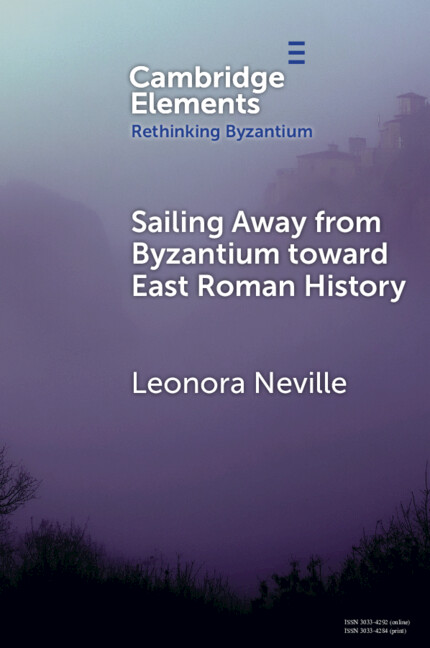
Professor Leonora Neville joins us to make the case for getting rid of the term Byzantium for good. She wants to replace it with a different term and a different understanding of Roman history.
Professor Neville is the John W and Jeanne M Rowe Chair of Byzantine History at the University of Wisconsin-Madison. She specialises in the 9-12th centuries of the Empire’s history. And her research has focussed on gender, civic religion, and religious aspects of political culture as well as historical memory and historiography.
She has written several excellent books which have been vital to this podcast. Her guide to Byzantine historians is essential reading for students. Her book on Byzantine gender helped direct my episodes on ‘Women in the Roman world’ and her book on provincial authority was extremely helpful in understanding Kekaumenos. She is also a Senior fellow at Dumbarton Oaks and an editor of several book series. Find out more at the University of Madison-Wisconsin website.
Stream: Get Rid of Byzantium
Download: Get Rid of Byzantium
RSS Feed: The History of Byzantium
If you want to send in feedback to the podcast:
– Either comment on this post.
– Or on the facebook page.
– Leave a review on Itunes.
 The History of Byzantium
I’m going to echo something Dr. Neville said–The History of Byzantium Podcast is absolutely not an impediment in understanding the East Romans!
I’ve personally switched to using the terms “the Eastern Romans” and “the medieval Romans” when discussing these people and their society. Before this podcast I ran into the usual disclaimers that “the Byzantines didn’t call themselves that”, and would often find the suggestion that they called their country something we couldn’t use in English because it was the name of a modern country (“Romania”) or because there’s no way to figure out how to pronounce it using the rules of written English (e.g. “Rhōmanía”).
This podcast was a corrective to all that and I hope that everyone recognizes you for your part in speaking for people who aren’t around to speak for themselves.
Robin, thank you for a wonderful episode. It is always a pleasure to listen to you and Dr. Neville discuss Byzantine history. I have listened to your podcast for many years but have never commented. I am a PhD candidate in Public History at Carleton University, Ottawa, Canada. My research interests and focus is on ancient and modern reception of “Byzantine” coins. In particular, I am interested in Digital Public Archaeology and the implications of this “Byzantine” identifier on numismatic data infrastructures and the problems that may ensue if and when the Byzantine label is rejected and the discipline adopts a new title.
This episode spoke to a lot of my research that I am working on for my dissertation. I have followed Dr. Neville’s work since I first pursued this field, and have spoken with her on many occasions about this problem of Roman Denialism. I read this book in the early summer of 2025 and agree with most of what is written. This comment is meant as a suggestion, though long winded, if there is a possibility for you to interview or explore the digital scholarship surrounding numismatics and Byzantine Studies. It is often overlooked but is very important for understanding the Roman world. If you wish to discuss this over email, I would be very happy to.
Thank you for a delightful and enjoyable podcast. Your work has inspired my research interests and I am very thankful for this.
Scott
Thank you both so much 🙂
I think there is a strong case for not differentiating between Romans and Byzantines as is commonly done. But she did a horrible job making that case.
She seems to take it for granted that removing a Christianity from its pivotal role in defining antiquity vs the middle ages is a good thing in itself. And thus the name should be changed. Or that removing a part of this great western story/myth is a good thing in itself.
This is a purely ideological argument, playing on political views she expects her counterpart to agree with her on.
I would have much preferred to get historical reasons why this naming is more appropriate and a comparison on the rights and wrongs.
But this was barely touched. She made one argument repeatedly: they called themselves, Romans. Obviously there are counterarguments, but sadly the conversation didn’t go that direction at all.
There are communities that have never lost that continuity in their oral histories or cultural practices. Armenians (since expelled) from near Antioch/Cilicia carry family stories of “Greek royalty.” Some Orthodox Christians in the Levant still will not start a new project on a Tuesday because Constantinople fell on a Tuesday.
The best example may be that Arabic-speaking Antiochian Orthodox call themselves (and are officially known as) “Roum,” i.e., Romans — perhaps truly the last! And to be clear, it very much means the ancient Romans (a different adjective would be used for, say, talking about Romans in Italy today, including the Roman Catholic Church).
It’s a great example of what Dr. Neville is saying and undermines the modern, static, racializing framework. It’s too bad that scholars from Western Europe and North America typically ignore these communities or relegate them to historical curiosities, which only serves to benefit the politicians and pundits who have benefitted from stoking an imagined crystal-clear dividing line since the crusading age.
So I’m encouraged by Dr. Neville’s work and Robin highlighting it on this great podcast. Would be great to bring on scholars who have done some of the specific anthropological and historical work on these communities!