
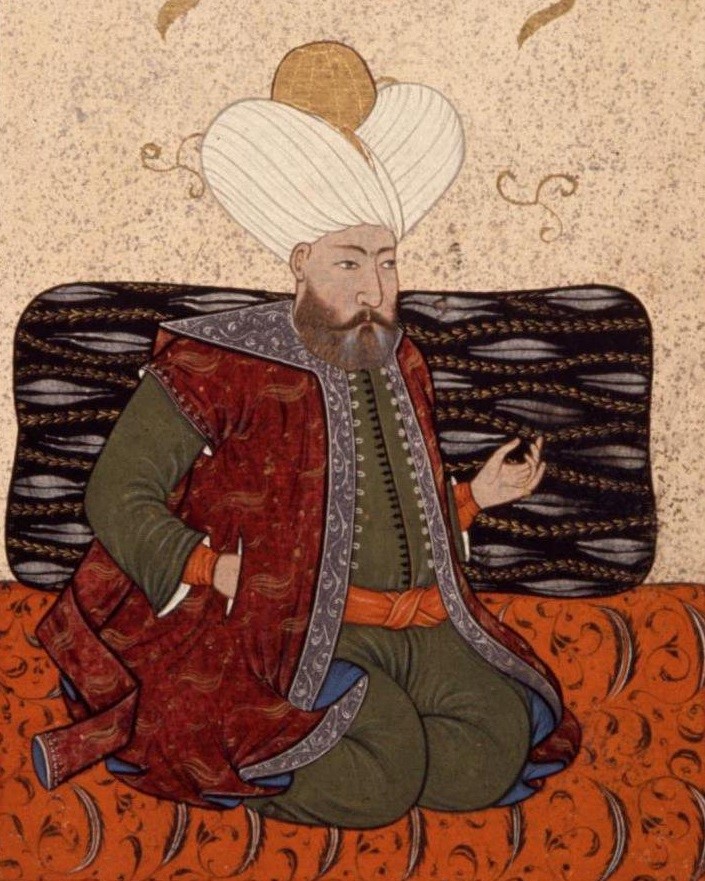
We look at the details of how the Ottomans ran their state. Including the creation of loyalty to the ruling dynasty, succession policy, military recruitment and slave trading.
Period: 1280-1371
Pic: Sultan Murad I (16th century miniature)
Stream: The Rise of the Ottomans, Part 2
Download: The Rise of the Ottomans, Part 2
RSS Feed: The History of Byzantium
If you want to send in feedback to the podcast:
– Either comment on this post.
– Or on the facebook page.
– Leave a review on Itunes.
 The History of Byzantium
About a year ago I finished Mike Dunkin’s history of Rome podcast. I immediately started listening to yours and couldn’t wait to learn more abut the Eastern Romans and their story. I caught up with you just before your last big narrative break. I just wanted to share how much I have been enjoying the podcast. Everything from great narration of the stories of our main protagonists and our “side characters”, to colourful portraits of byzantine culture, detailed depictions of battles, their government and military systems, the interviews with many great guests (most notably professor Kaldellis), and subtle humour where it fits. It has easily become one of my favourite podcast I’ve listened to, and I recommend it to everyone I know is a fan of history like myself. I can’t wait to listen to it till the end, while at the same time not wanting it to ever end XD. Keep on the amazing work, and much love ❤️
Thank you so much 🙂
Robin, thank you for your work on the podcast. I completely understand your decision not to continue the narrative past (or at least much past) 1453. However, I feel the need to push back on some of the discussion you gave at the end of this podcast episode.
First, you state that some scholars trace a level of continuity between the Ottoman Empire and the Roman Empire due to some background assumption that all empires are the same. I do not believe this is the case for specialist scholars who trace this continuity. Marc David Baer argues for a level of continuity based on specific evidence of Roman ethnic identification within the Ottoman state. With all due respect to Antony Kaldellis, who waves away any kind of continuity, it would be natural for people who personally identify with a Greek tradition to take the “no continuity” side of the argument. Nevertheless, the truth is that the Roman story started with Latin-speaking pagans and transformed into a story about Greek-speaking Christians, so it is not unreasonable in any way for the story to shift to include some Turkish-speaking Muslims.
Second, you argue that the Ottoman Empire is completely different from the Roman Empire because the former is a mix of Mongolic/Turkic and high Islamic cultural influences. This deeply discounts the strand of Roman administrative continuity in provinces like Bithynia and the continuity of this “reasonable to the Christians in the settled city, but friend to the nomads in the fields” approach with the Seljuks of Iconium. A fairer reading would be that the Ottoman Empire combines strands of Mongolic/Turkic, Islamic, and east Roman influences in a dynamic evolution.
Third, you claim that you wouldn’t be able to provide fair critical analysis of the Islamic Ottoman Empire since you come from a Christian cultural context. I find this concerning simply because the majority of the Ottoman Empire’s subjects were actually Christians for a long period of its history, and even after it absorbed sufficient Muslim populations to change that, many provinces continued to have very large Christian populations for generations. How can it be that nobody from a Christian cultural context or with Christian assumptions (in the Tom Holland Dominion sense) can discuss historical events that affected millions of Christians just because the rulers had a different religion?
Fourth, I would suggest that you overstate the “settler nomad” aspects of the rise of the Ottomans by interpreting patterns through that lens rather than relating them to patterns present elsewhere. For example, ties of personal and dynastic loyalty are present in many late medieval and early modern European contexts. Did the Ottomans believe in the unity of their state because of some kind of recent nomad beylik experience or because of a garbled interpretation of the doctrine of the united house of Islam (dar al-Islam)?
Again, I think it is entirely reasonable to conclude the podcast at 1453 and I applaud you for your work to bring this project to a close. However, I find issue with the discussion, particularly toward the end of this episode.
I think it is in principle good when historians are interested in continuity, but you have to draw the line somewhere. Every new state retains some institutions and practices of its predecessor, but that does not mean they are not a new regime, or even a new civilization.
For example – the Achaemenids retained a lot of the structures of the states they swallowed, their institutions were then retained by Alexander and the Seleucids, than the Parthians took over a lot of the Hellenistic administration, which was then likely at least partially preserved by the Sassanids, whose governance practices were then partially preserved and used by the Caliphate, its successor states, the Seljuks and so on. But that doesn’t mean that we should see medieval Iran as just Achaemenid Persia by another name. Obviously.
In the case of the pagan Romans and Byzantines and the Ottomans – the Christian takeover of the Roman Empire was from the inside, via a conversion of the elites and a gradual change in the state’s ideology. It was a change in the identity of a continually existing state. The Ottoman takeover was a violent external invasion which included a brutal battle for Constantinople, as well as the enslavement of a significant amount of Greeks/Romans. I do not think at all that we should connect the two processes. The fact that the Ottoman sultans took over the title of Caesar and presented themselves to some extent as a continuation of Byzantium is an interesting aspect of the Ottoman Empire, but I do not think we should just except it verbatim and say that the Roman Empire lasted all the way to 1924, or something.
Well said
While I respect the judgment that something truly changed and totally accept Robin’s decision to end the podcast around 1453, I still have to push back. This is again overemphasizing the nomadic invasion aspect of the situation and overlooking the continuous Greek/Roman demographic role in the Ottoman empire, which it maintained up until the 1920s collapse.
I certainly did not say we should simplistically accept the Ottoman ruler’s claim to be Caesar, but it does point to a more complex phenomenon than thinking this is just completely different from the Roman Empire. The Ottoman Emperor sat in Constantinople, claimed to be Caesar, and ruled over an ethnic group called Romans (Romioi) governed by Roman laws under the millet system for hundreds of years. That is a more complex phenomenon than just “the Roman Empire ended.” And it certainly points to a more complex inheritance for the Ottoman Empire than just Turkish nomadic and high Islamic.
I also certainly did not claim that medieval Persia was a continuous culture with Achaemenid Persia.
Finally, this focus on the violent invasion of Thrace or the fall of Constantinople also overlooks the true demographic situation, which played out over many centuries as a mix of Greek, Armenian, and Muslim (and also Jewish!) peoples continued to live in close proximity throughout the Empire. If one imagines that in 1300 everybody in Thrace was a Greek Christian and in 1454 all the Greeks were slaves and the population was 75% Muslim, one’s imagination is wrong. There were parts of modern Turkey, on the Asia side, that were half or a majority Greek as late as the 1800s. Greek-speaking Romans maintained substantial levels of government authority under the millet system. Romanness did not disappear in 1454.
Again, I completely respect ending the story at 1453 and am not claiming some kind of naive continuity. However, I detect a serious lack of nuance in the discussion being advanced. There is a saying attributed to Voltaire that the Holy Roman Empire was neither holy, nor Roman, nor an empire. The same could not be said of the Ottoman empire as a successor to the Roman Empire.
Completely agree Jared, perfectly fine to have a view but I find it risible that the Ottomans are being portrayed as some uniquely horrible empire. Arguably giving your political opponents a clean death rather than mutilating them and forcing them to live in extended agony to satisfy a hypocritical interpretation of religion makes the Ottomans more merciful than the Byzantines. Speaking of religion, the Ottomans showed the religious minorities in their realm a latitude that the Byzantines wouldn’t have dreamed of showing. Frankly, I feel you’ve got a bit too close to your subject Robin. You have previously given esxcellent warnings against seeing the Byzantines as heroes and their enemies as villains. Time for a revisit?